


One of the great pleasures (or tragedies, depending on whether you’re a glass-half-full or empty kind of person) in life is going back in time, sometimes as recent as a few years back, and discovering all kinds of amazing movies that somehow flew under your radar when they first came out in theaters. Whether it’s due to sheer ignorance (forgivable) or lack of interest (unforgivable) is irrelevant now, because with everyone staying home with jack shit to do and a deluge of creatively vacant crap flooding our streaming services and cinemas, this is the perfect time to look back in time and check out some of the best movies you definitely have not seen yet. Below are my favorite films that were criminally ignored by the box office, and you.
Shattered Glass (2003)

Having just been critically maligned for half a decade over his whiny man-child portrayal of Anakin Skywalker, Hayden Christensen’s first post-Attack of the Clones feature is a shockingly insightful examination in journalistic sensationalism and its ability to cloud the judgement of those who engage in it, whether it’s the author’s or the audience’s.
Shattered Glass is based on a true story in which New Republic writer Stephen Glass was discovered to have fabricated many of his smash-hit stories. The real magic of this movie is how it works on two levels to trick you, the viewer, into sympathizing with Glass. On one level, Christensen portrays Glass as a well-meaning, dopey but fun kid who doesn’t seem to be aware of his uncanny ability to discover and tell the most captivating stories. When newly promoted editor Chuck Lane, who is incredibly unlikable and writes more straight-laced stories, starts investigating the veracity of Glass’s stories, the movie uses the staff’s unified support of Glass to trick the viewer into assuming a good guy vs. bad guy dynamic between Glass and Lane, respectively. On the second level, the movie uses this dichotomy to mirror the tendency for people to be drawn towards sensationalism instead of objective reporting. Glass, who is animated and highly sympathetic, appears to be the protagonist, while Lane, who shows little emotion, appears to be the antagonist. The brilliance in Shattered Glass is how it almost imperceptibly reveals the true dynamic between these two characters, like the answer to a puzzle that was staring you in the face the entire time.
Spartan (2004)
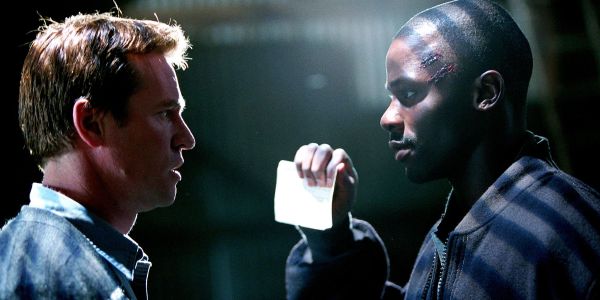
Starring Val Kilmer, Derek Luke, and a pre-Frozen Kristen Bell, David Mamet’s Spartan stands far apart from its military thriller counterparts with its one-of-a-kind blend of plot twists, realism, and hypnotic dialogue. Val Kilmer portrays Bobby Scott, a Delta Force operator tasked with finding the POTUS’s kidnapped daughter (Bell). In the pantheon of modern cloak-and-dagger agents like Jason Bourne and Jack Bauer, Scott makes all of them look like clumsy caricatures of the real thing. That’s because his persona is based on a real-life ex-Delta operator, Eric Haney, and the brutal, machine-like precision with which he speaks and moves is cinematic gold. At one point, he tells a rescued sex slave to “shut your fucking mouth” to avoid alerting the enemy, and punches her in the gut shortly after when she doesn’t comply.
The dialogue is unlike anything you’ll ever hear in a movie. Every word and line is so masterfully crafted that subsequent viewings always seem to reveal new subtleties that you missed the previous time. Take this exchange for instance, in which Scott’s protege Curtis asks him if Scott’s superiors are sending him to find the President’s daughter.
Curtis: They sending you in?
Scott: We’ll leave that to our betters.
Curtis: Why don’t you ask them?
Scott: Why would I want to know? I ain’t a planner, I ain’t a thinker. I never wanted to be. You got to set your motherfucker to receive. Listen to me. They don’t go through the door, we don’t ask why. That’s not a cost, it’s benefit. Because we get to travel light. They tell me where to go. Tell me what to do when I get there.
Amid the heavy shop-talk and countless plot twists, the movie never loses clarity on the driving force behind the plot, with various characters repeatedly asking “Where’s the girl?” as a means to anchor everything down. Spartan is an extraordinarily sophisticated spy thriller and demands the same level of sophistication from you in order to catch all of its hidden weapons.
In the Bedroom (2001)

Directed by Todd Field, this slow-burning, ultra-realistic family drama is so zen-like in its execution that it might as well have been directed by Stanley Kubrick. Although it implies a sappy romance, the title is actually a reference to how more than two lobsters trapped in a lobster cage will inevitably kill each other.
There’s not much I can say about the plot here, as much of its power stems from a shocking plot twist that happens about a third of the way in. The story takes place in a sleepy town in Maine, and involves a young man (Nick Stahl) dating an older woman (Marisa Tomei) who also has two kids, much to his parents’ (Tom Wilkinson and Sissy Spacek) disapproval. It may sound quite mundane at first, and In the Bedroom starts off seeming like it’s going to be a certain type of movie, but after said plot twist, it veers down a different path and reveals its true nature as something much darker than you expected.
In The Bedroom is ultimately about how the darkness that lurks within us will eventually have its day, one way or another. Until it does, everything we do to maintain a sense of normalcy is a lie. There are good and bad ways to let that darkness out, and the characters do so with varying consequences. The tension of anticipating which path they choose is what drives the narrative forward, culminating in a bit of a surprise ending you’re not likely to see coming.
The Place Beyond the Pines (2012)

Despite being 140 minutes long, Derek Cianfrance’s The Place Beyond the Pines feels like it could have been twice as long in the hands of a less capable director. The movie weaves together a crime story from three different perspectives, each chronologically happening one after the other. Most other films with this premise would use non-linear storytelling to maintain a better sense of continuity, but this one instead adopts a refreshingly unique linear sequence of events, where the narrative baton gets passed onto a new character every third of the way through and the audience gets what initially seems like a new story taking place in the same world.
TPBTP looks at how one’s actions ripple outwards across time, passing the consequences onto new generations . The two central characters, stunt biker-turned-bank robber Luke Glanton (Ryan Gosling) and police officer Avery Cross (Bradley Cooper) are men who both want more for themselves, whether for selfish reasons or to support a family. Every detail of how they pursue those goals echoes throughout the years, down to how their sons turn out when they become teenagers. One character, who pursues his ambition for selfish reasons, winds up becoming very successful, but ends up with a son who is spoiled and uninspired. The other character, who breaks the law to to support his family, ends up with a son who is close to his family but plays fast and loose with the law.
On top of it all, TPBTP boasts some truly gripping action, with an incredible bank robbery and chase sequence more realistic than most of what you’ll see in the genre.
Bone Tomahawk (2015)

Rounding out this list is probably the best western horror movie ever made, Bone Tomahawk. The premise is simple: a tribe of cannibals has kidnapped some townsfolk, and a group of volunteers including Sheriff Hunt (Kurt Russel) and Arthur (Patrick Wilson) set out to rescue them.
Director and writer Steven Craig Zahler likes his films slow, long, and gory (see my review of his most recent movie, Dragged Across Concrete), and Bone Tomahawk practically screams those qualities. After establishing its premise, the movie slams into an agonizingly slow pace in which the rescue party, led by Sheriff Hunt, march across the desert plains to rescue their people. This journey, which encompasses half the movie, is filled with conversations between the characters and their understandings of each others’ motivations for joining the mission. All of this is to build them up as much as possible, because after seemingly forever, all hell breaks loose and the movie suddenly turns into an unhinged bloodbath in which limbs are chopped off, heads are severed, and a man is scalped before being torn in half vertically in one of the most stomach-turning sequences in recent memory.
Bone Tomahawk is a classic example of a movie that rewards your patience and attention with some of the most visceral action put to film. With every gunshot and gory dismemberment, you feel for the characters because you’ve journeyed with them across the desert and understand who they are inside. With an immensely satisfying conclusion, this is definitely a must-watch if you like your westerns bloody and thoughtful at once.
 THE REBEL XENO